
Executive Summary:
The Workshop on Green Financing Energy Efficiency Technologies (EETs) for Shipping Companies, held on 20 May 2026 at the Hong Kong University of Science and Technology (HKUST) Jockey Club Institute for Advanced Study, examined how small and medium-sized shipping companies (SMSCs) can be incentivised to adopt EETs on in-use vessels. Organised by the Institute for the Environment, the workshop complemented the morning forum by shifting from technical options to finance, taxonomy design, risk sharing, and policy signals.
The workshop found that the constraint is not a simple shortage of technologies or capital. Lower-cost measures such as propeller-related energy-saving devices, hull measures, and coatings are already being used, while higher-capex options such as shaft generators, waste heat recovery, battery energy storage, wind propulsion, and air lubrication remain more dependent on vessel profile, operating days, payback period, crew use, and regulatory support. Three barriers emerged. First, savings must be measured credibly at vessel level before financiers can price risk. Second, many finance and taxonomy frameworks still fit large companies, newbuilds, or corporate-level climate performance better than individual vessel retrofits. Third, shipowners, financiers, and technology providers need stronger policy and market "heat" before higher-capex EETs can move beyond selective adoption.
Participants identified four priorities:
- Standardise vessel-level performance data, documentation, and third-party verification for retrofit projects.
- Design finance structures for EET adoption, including public-private funds, leasing, securitisation, blended finance, and pay-as-you-save models.
- Adapt green and transition finance taxonomies so that verified EET retrofits and vessel-level decarbonisation investments can qualify for support.
- Use Hong Kong's maritime, legal, banking, leasing, insurance, and trading ecosystem to distinguish decarbonisation finance from conventional shipping finance.
The conclusion was clear: Hong Kong has many of the ingredients for green shipping finance, but EET adoption will scale only if policy signals, retrofit taxonomies, verified performance data, and bankable project structures are brought together.
Technical Summary:
Workshop Objective and Context
The workshop examined the enabling conditions needed to incentivise local and regional SMSCs to adopt EETs on in-use vessels. It was designed as a participatory session involving shipowners, ship managers, technology providers, financiers, leasing companies, classification societies, and NGOs. The workshop placed greater emphasis on open-floor discussion, practical constraints, and finance design.
The central problem was the vessel-level financing gap. Many EETs generate savings through reduced fuel consumption, but those savings can be difficult to measure and may accrue to a charterer rather than the shipowner who pays for the retrofit. Financiers, meanwhile, need verified performance data and standardised documentation before they can price risk or offer better terms. The workshop therefore focused on how technology selection, performance verification, taxonomy design, and finance structures can be combined.
Part I: What are preference and response of shipping companies and advice of technology providers on EETs
Keynote Presentation: Energy Efficiency Technologies
Mr. Daniel Song opened the workshop by reviewing shipping emissions trends and the EET landscape. Drawing on industry data, he noted that ship efficiency has improved over time and that more than half of the fleet now has at least one EET installed, compared with roughly one-third five years earlier. However, total fleet greenhouse gas emissions have increased since 2020, reflecting fleet growth and longer voyages linked to economic and geopolitical factors. This creates pressure to accelerate both operational and technical efficiency improvements.
Mr. Song separated operational measures, such as trim optimisation and weather routing, from technical EETs that require equipment installation and capital investment. Lower-cost technical measures include energy-saving devices before and after propellers, high-efficiency propellers and rudders, LED lighting, low-friction coating, and hull-line optimisation. Higher-cost and more innovative options include solar panels, wind propulsion, air lubrication, retrofit shaft generators, onboard carbon capture, waste heat recovery, battery energy storage, and onshore power supply. His presentation set the practical question for the workshop: which technologies are mature enough, reliable enough, and financially attractive enough for existing fleets?
Open-Floor Discussion
The first discussion began with a vote on five shortlisted EETs using four criteria: high energy saving, high reliability and maintenance friendliness, low operating expenses, and short breakeven time. Shaft generators received the strongest support, followed by battery energy storage systems, waste heat recovery, wind propulsion, and air lubrication. The result reflected a preference for technologies whose economics and operational use cases are more readily understood.
Shipowner comments showed why selection must be vessel-specific. From the shipowner side, one representative described a low-hanging-fruit strategy using pre-swirl stators, propeller boss cap fins, rudder bulbs, full underwater hull blasting, and moderate-quality antifouling paint. A third-party study indicated approximately 10 percent savings from the combined package, with roughly half from coating and hull measures and half from the energy-saving devices. The representative emphasised low operating cost, minimal maintenance beyond dry-dock inspection, and a stepwise approach in which spending increases as carbon-compliance pressure grows.
A second shipowner perspective was more cautious about higher-capex technologies. Shaft generators may be viable for vessels with long sailing periods, but payback deteriorates when annual sailing days are limited. Waste heat recovery remained under study. Batteries were viewed as unsuitable for ocean passages under current energy-density limits. Wind propulsion and air lubrication were treated as promising but still dependent on route profile, installation cost, operating conditions, maturity, and regulatory or carbon-price support. The representative also described silicone coating across more than 60 percent of the fleet, with charter-party fuel-consumption assumptions adjusted downward by 8 percent where savings could be reflected commercially.
Technology-provider comments reinforced that there is no one-size-fits-all solution, and EETs interact with one another and with vessel operations. Shaft generators can be highly effective when they replace auxiliary generator load, while air lubrication and some wind devices are themselves power consumers. Savings depend on equipment integration, crew behaviour, hotel load, voyage profile, and maintenance.
The discussion also drew a parallel with scrubbers: adoption accelerated only when the International Maritime Organization (IMO) 2020 sulphur cap gave shipowners a clear compliance trigger and a stronger investment case. High-capex EETs may follow a similar path, with wider uptake depending not only on technical maturity but also on policy certainty, carbon-pricing signals, and recognised incentives for verified efficiency gains.
Part II: What enabling conditions are crucial to incentivize local SMSCs to adopt EETs on in-use vessels
Keynote Presentation: Financing for Shipping decarbonization
Ms. Gu Beibei presented China's policy and market development in sustainable finance for shipping decarbonisation. She highlighted a large transition finance need across newbuilds, retrofits, port infrastructure, and the wider maritime value chain. While dual-fuel readiness in newbuilds has improved, conventional finance remains concentrated among large companies with strong credit profiles, leaving smaller companies and value-chain participants with access and cost barriers.
China's policy framework includes the 2024 Green and Low-Carbon Transition Industry Taxonomy, evolving green finance taxonomies, Common Ground Taxonomy work with other jurisdictions, and the People's Bank of China's carbon-emission reduction lending facility. Local experiments are also significant. Shanghai's transition finance taxonomy includes shipping as a target sector and links basic and advanced levels to IMO-related indicators such as Carbon Intensity Indicator and Energy Efficiency Existing Ship Index. This local taxonomy is being considered as a basis for a national shipping transition finance standard.
The market has begun to respond through green shipping loans, ESG syndicated loans, green bonds, blue bonds, sustainability-linked bonds, leasing, insurance, and integrated financing approaches. Gu Beibei highlighted examples where loans are linked to Poseidon Principles or IMO-related performance indicators, and where transition finance is combined with third-party assessment and continuous monitoring. She also stressed the need to move beyond single-vessel or single-company finance toward value-chain approaches that include green fuels, ship retrofits, port infrastructure, and cargo-owner demand.
The main barriers remain integrated value-chain support, access to finance for small and medium-sized enterprises, credible data, risk pricing, and data-sharing mechanisms. For financiers, verified emissions impact is essential. Without trusted data, preferential capital cannot be confidently allocated and the long-term value of retrofitted vessels remains difficult to assess.
Open Floor Discussion
The second open-floor discussion explored what Hong Kong can do to support EET adoption and retrofit finance for SMSCs. A finance-sector contributor proposed a public-private investment fund anchored by public capital and managed by specialists with both Securities and Futures Commission (SFC) licensing and shipping knowledge. To reduce transaction costs, the fund would need homogeneous asset classes, similar equipment types, standardised legal and certification documents, and sufficient project volume. The same contributor also proposed securitisation as a way to bundle loans for equipment such as battery energy storage systems and power take-off units into investable notes in US dollars, Hong Kong dollars, and renminbi.
A ship finance practitioner argued that Hong Kong already has many of the ingredients needed for shipping finance innovation: common law, British admiralty law, a freely convertible currency, a deep shipowning and ship-management community, insurers, traditional banks, and leasing companies. He suggested that banks and leasing companies could work together more effectively, combining banks' syndication capacity with leasing companies' asset-based risk appetite. If linked to verified EET performance and regulatory incentives such as the European Union Emissions Trading System (EU ETS) and FuelEU Maritime, Hong Kong could build a cycle of technology adoption, performance validation, and financing innovation.
A banking representative involved in retrofit finance noted that the Global Centre for Maritime Decarbonisation's (GCMD) Fund for Energy Efficiency Technologies (FEET) programme already pre-funds retrofits through a pay-as-you-save model. If such a model works in Singapore, she argued, Hong Kong should be able to replicate it because the legal and financial structures are comparable. This shifted the discussion from inventing entirely new products to adapting credible models that already have market participation.
The discussion repeatedly returned to the need for policy and regulatory "heat." Technologies and finance both exist, but shipowners remain cautious where savings are uncertain and commercial triggers are weak. Taxonomy design was identified as a specific friction point. Transition finance taxonomies often do not fit retrofits well, meaning that a credible EET investment may fail to qualify for capital relief or regulatory benefit. Several contributors argued that Hong Kong's forthcoming five-year plan provides an opportunity to distinguish traditional shipping finance from decarbonisation finance and to define what policy signals, taxonomy criteria, and institutional arrangements are needed.
The workshop also broadened Hong Kong's potential role beyond finance. The discussion suggested that the city could develop trading capabilities not only for green fuels but also for EET-related assets and services. This would build on Hong Kong's banking, legal, insurance, and maritime infrastructure while connecting to Mainland China's green industrial policy and supply chains.
Key Outcomes
The workshop identified five practical requirements for scaling EET adoption:
- Vessel-level performance data must be credible, standardised, and usable in finance decisions.
- Retrofit finance must address split incentives between shipowners, charterers, technology providers, and financiers.
- Taxonomies should recognise EET retrofits and vessel-level transition investments, not only corporate-level performance or newbuilds.
- Public-private funds, securitisation, leasing, blended finance, and pay-as-you-save structures can help turn small projects into bankable portfolios.
- Hong Kong should use its five-year planning process to define decarbonisation finance as a strategic maritime opportunity, distinct from conventional shipping finance.
The workshop concluded that the obstacle is not a lack of technologies or a lack of capital. The real challenge is coordination: aligning policy signals, verified performance, finance structures, and market demand so that existing vessels can be retrofitted at scale.
[Draft and subject to change]
| Time | Sessions | Speakers | Presentation |
|---|---|---|---|
| Part 1: What are preference and response of shipping companies and advice of technology providers on EETs (30 mins) | |||
| 2:15 – 2:25 PM | Energy Efficiency Technologies | Daniel Song / BV | |
| 2:25 – 2:45 PM | Open Floor Discussion:
o “Vote 2 out of 5 shortlisted EETs that meet most of the 4 criteria - High energy saving, High reliability & maintenance friendly, Low operating expenses, Short breakeven time; o For shipping companies, what are the current and planned EETs/ why no EETs and how you will select? o For technology providers, what EETs are mature and proven and how you will rank priorities among criteria like crew training, lifecycle management, payback time, etc.?” |
Lingfeng Han/ BV (Moderator) | |
| Part 2: What enabling conditions are crucial to incentivize local SMSCs to adopt EETs on in-use vessels (70 mins) | |||
| 2:45 – 3:00 PM | Financing for Shipping decarbonization - A review on Policy and Market Development from China | Gu Beibei / Green Finance Forum of 60 (GF60) | |
| 3:00 – 3:55 PM |
Open Floor Discussion:
|
Christine Loh/ HKUST (Moderator) | |
| Summary / Closing Remark (5 mins) | |||
| 3:55 – 4:00 PM | Summary / Closing Remark | Christine Loh/ HKUST | |
| 4:00 PM onwards | Coffee / Tea Time for Networking – on ground level, foyer of IAS | — | |
1 One of the enabling conditions is a green and transition finance taxonomy that supports ship retrofitting with EETs.
| No. | Organization / Company | Name of Speaker | Job Title |
|---|---|---|---|
| 1 | BV | Daniel Song | Head of Expertise Center Sustainability, Future Shipping Team |
| 2 | BV | Lingfeng Han | Bureau Veritas, M&O Hong Kong Manager |
| 3 | GF60 | Gu Beibei | Vice President |
| 4 | HKUST | Christine Loh | Chief Development Strategist |
Speakers' Biographies:

Daniel SONG
Daniel SONG, Head of Shipping Expertise Center Sustainability, Future Shipping Team (FST). Joined Bureau Veritas in 2021, in charge of the technical and marketing support for the ship's sustainability, doing the research of the shipping's alternative and innovation technologies.
Graduated from Dalian Maritime University with Master degree in Marine Engineering.

Lingfeng HAN
Lingfeng Han started his career from Hong Kong Ocean Tramping Company limited as Engine Cadet, after graduated from Ji Mei university in year 1993. He studied for a MSc of Marine Engineering at the University of Strathclyde in 2004, after his last sailing command as Class 1 Marine Chief Engineer in 2003. He then worked for various international companies in senior management roles including V. Ships UK Ltd, Seapeak (ex-Teekay LNG), Flex LNG and IMC Ship Management.
In year 2024, He joined Bureau Veritas Marine and Offshore Hong Kong as General Manager.

Beibei GU
A dedicated sustainability professional, Beibei Gu brings over a decade of experience in research, policy advocacy and project management in the field of green economy, climate finance and sustainable growth. She has advised UN organisations, development agencies, financial institutions, philanthropy and civil society organisations in China and across the emerging market on strategy, impact and partnerships building. She currently serves as the Vice president of Shanghai Jinsinan Institute of Finance, overseeing strategic partnership and international cooperation through the Green Finance Forum of 60, an international platform convening global figures and thought-leaders from finance, business and sustainability fields with a mission to mobilize innovative capital for climate solutions in China and beyond. Ms. Gu holds a master’s degree in Global Environmental Policy from American University in the US and a bachelor’s in Environmental Engineering from Tongji University in China.
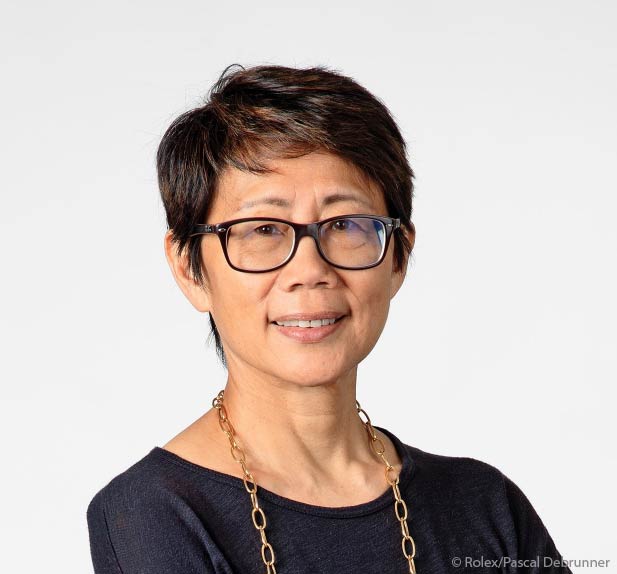
Christine LOH
Prof. Christine Loh is the Chief Development Strategist at the Institute for the Environment, Hong Kong University of Science and Technology (HKUST). Previously, she held the positions of Special Consultant to the Office of the Chief Executive of the HKSAR Government on the ecological civilization aspects of the Greater Bay Area Outline Development Plan (2019-2020); and Under Secretary for the Environment in the HKSAR Government (2012-2017). She was the CEO of Civic Exchange, an independent non-profit public policy think tank (2000-2012). Before that, Prof. Loh served as a member of the Hong Kong Legislative Council, first appointed in 1992 and later elected in 1995 and 1998. Earlier, she spent 14 years in the private commercial sector in commodities trading. Currently, she is a Director of New Forests Pty Limited, Towngas Smart Energy Company Limited, CDP Worldwide, and Global Maritime Forum. She is also a founding Advisor to Hong Kong Green Finance Association.


