



Climate change is a complex institutional challenge that cuts across government, markets and communities. While Hong Kong has set long-term climate targets, it still faces critical delivery gaps in cross-cutting coordination, policy integration and long-term accountability.
HKUST's Division of Environment and Sustainability has embarked on a project, "Strengthening Hong Kong's Capacity to Achieve Sustainability and Shape the Sustainable Development Narrative through Policy Innovation", involving three related dimensions: Climate Governance, Ecological Civilization and the application of governance thinking into industry transformation. Climate Governance uses a governance lens to examine how climate policy can be translated into practical implementation. Ecological Civilization draws on China's national guiding philosophy and development principle to consider how sustainability can be understood as part of Hong Kong's long-term climate, ecological and socio-economic resilience. Industry applications enable these governance concepts to be tested and refined through engagement with stakeholders facing real-world transition challenges.
Together, this project asks how Hong Kong can move from policy ambition to implementation. The Climate Governance workstream helps identify the institutional conditions needed for action, while the Ecological Civilization workstream explains why sustainability should be placed at the centre of Hong Kong's long-term development strategy.
 Climate Governance Workstream
The Climate Governance workstream examines Hong Kong's climate policy and implementation challenge from a governance perspective. It asks not only what policies Hong Kong should adopt, but how public institutions, markets and stakeholders can be better aligned to deliver outcomes.
This workstream is not a conventional sectoral policy review. It is a governance inquiry into how Hong Kong can strengthen its capacity to deliver cross-cutting transition outcomes within its existing executive-led system. It focuses on the institutional conditions needed for action: clear direction, accountable leadership, policy integration, finance and market development, and sustained transparency and engagement. Click to read the workstream's scoping, methodology and evidence base.
Workstream Phases
The Climate Governance workstream has been developed in six stages, with each stage serving a distinct purpose and building on the previous one:
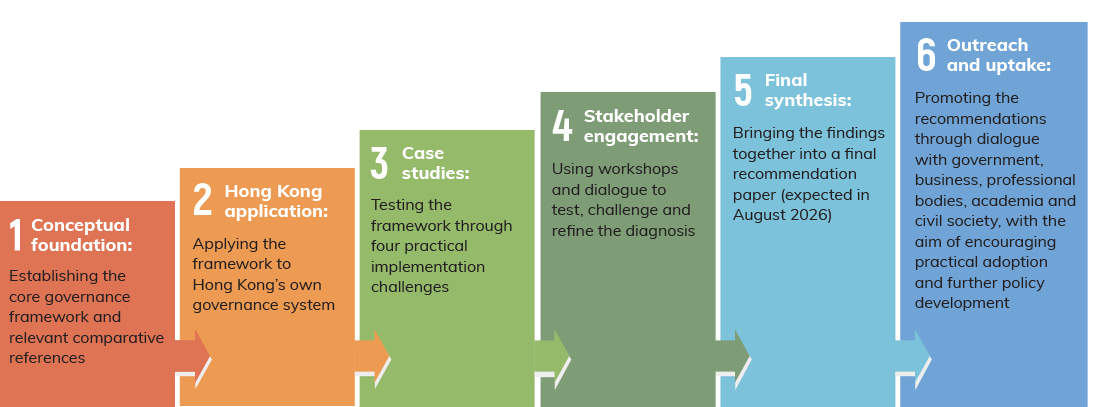
The workstream can therefore be understood as a funnel, moving from broad inquiry to practical recommendations and uptake:
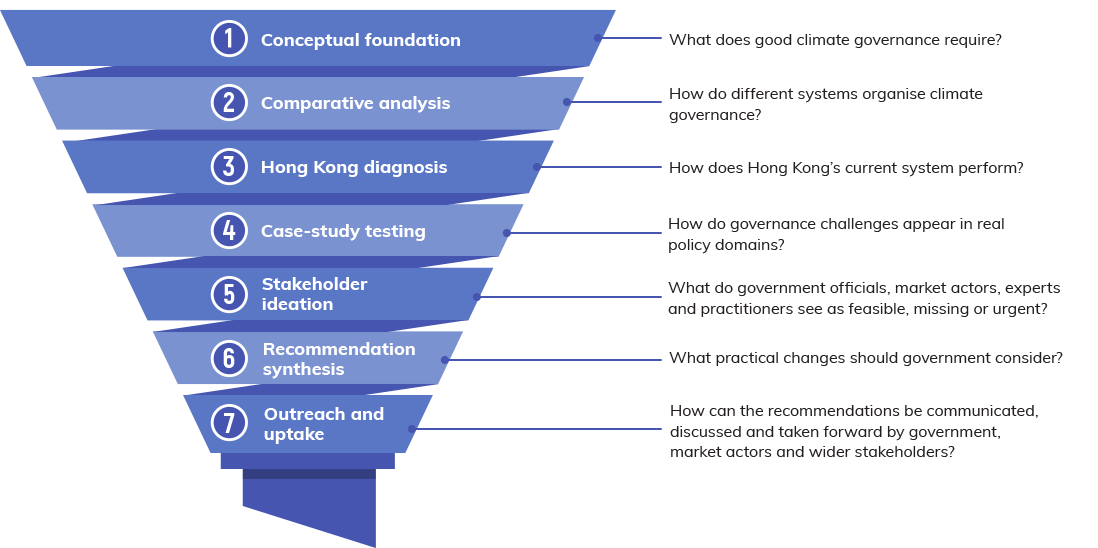
Research Papers and Workshop Summaries
A number of papers have been produced as part of the Climate Governance workstream. They should be read as background papers that supported the workstream's development. As the workstream progressed, its framing evolved through research, case-study testing, workshops and stakeholder feedback.
At this stage, the workstream has prepared three sets of background papers, together with a short briefing document for workshop participants. These materials were designed to structure discussion, establish a shared vocabulary, and identify governance questions for participants to test, challenge and refine through dialogue.
1. Strengthening Climate Governance: From Targets to Delivery in Hong Kong [April 2026]
 Analytical Foundation [ENG | CN]
This pack established the workstream's analytical foundation by framing climate change as a systemic governance challenge. It reviewed international experience from the United Kingdom, Mainland China, Singapore and Hong Kong to examine how different political and administrative systems organise long-term direction, leadership, coordination, accountability and stakeholder engagement. This comparative work informed the initial Five-Pillar Model of effective climate governance.
 Applying the Governance Framework [ENG | CN]
This pack applied the Five-Pillar Model to Hong Kong's governance system. It examined how Hong Kong's institutions, bureaux, departments, advisory bodies, regulators and coordination mechanisms support or constrain climate policy delivery.
 Case Studies [
This pack tested the framework through four case studies: retrofitting existing buildings, biodiversity and BSAP/NbS, shipping and port decarbonisation, and green finance. The cases were selected because they reveal different types of governance challenge, including market formation, cross-bureau coordination, infrastructure transition, stakeholder engagement and the connection between finance and real-economy implementation.
2. CEPU Paper [April 2026]
Improving Governance Mechanisms Under an Executive-Led System.
In April 2026, HKUST was invited to submit a paper to the Chief Executive's Policy Unit (CEPU) as part of CEPU's work to gather ideas for the preparation of the HKSAR Government's first Five-Year Plan. The paper reflected the Climate Governance Project's thinking at that stage of development. It translated the project's governance analysis into a strategic, government-facing argument, examining climate governance through three connected lenses: Hong Kong's executive-led system, the forthcoming local Five-Year Plan, and alignment with the National 15th Five-Year Plan.
3. Workshop Summaries [May-June 2026]
Between May and June 2026, the Project Team hosted a series of workshops to test and refine the workstream's diagnosis with different communities of experience. Participants included former senior government officials, built environment professionals, corporate sustainability professionals, board members, senior executives, maritime stakeholders, financiers, biodiversity practitioners, academics and NGO representatives.

7 — Insights from built environment professionals and other interested parties
8 — Insights from former senior government officials
13 — Insights from corporate sustainability professionals
20 — Insights from shipowners, financiers and maritime stakeholders

9 — Insights from board members and senior corporate executives
 Ecological Civilization Workstream
Ecological Civilization is now a central national development strategy in China. It offers a comprehensive framework for rethinking how economic growth, finance, technology and society can be organised to live within ecological limits.
This workstream aims to make the concept of Ecological Civilization more understandable and actionable in Hong Kong. Through policy analysis and media collaboration, it explores Hong Kong’s sustainability role in relation to national development, the Greater Bay Area, green development, biodiversity, finance and international discourse. It asks how Hong Kong can interpret Ecological Civilization in its own context and contribute to long-term climate, ecological and socio-economic resilience.
Publications
Paper
Ecological Civilization: National Strategy, Sustainable Development, and Hong Kong's First Five-Year Plan. April 2026. [ENG | CN]
This paper explores how Hong Kong can translate the national concept of Ecological Civilization into practical action through its first Five-Year Plan. It proposes six mission-oriented strategies, spanning green finance, building retrofits, biodiversity, Greater Bay Area cooperation and other areas to leverage Hong Kong’s distinctive strengths as a global “super connector” for sustainable development.
Articles
- Loh, Christine. "Hong Kong’s 5-year plan needs ambition to match Beijing’s expectations". South China Morning Post, 9 August 2026,
- Loh, Christine. "When everyone is a contractor, who is responsible?" China Daily, Hong Kong Edition, 2 August 2026.
- Loh, Christine. “Hong Kong must become a trusted multisystems hub”. China Daily, Hong Kong Edition, 28 June 2026.
- Loh, Christine. “Hong Kong’s first five-year plan needs a governing proposition”. China Daily, Hong Kong Edition, 24 June 2026.
- 陸恭蕙。“變局下的ESG:企業競爭力的一部分”, Ming Pao, 15 June 2026.
- Loh, Christine. “Hong Kong must prove significance as valued partner in national plan”. China Daily, Hong Kong Edition, 2 June 2026.
- Loh, Christine. “HK’s tourism is a deeper story about its evolving identity”. China Daily, Hong Kong Edition, 6 May 2026.
- Loh, Christine. “HKSAR’s challenges warrant mission-oriented governance”. China Daily, Hong Kong Edition, 21 April 2026.
- Loh, Christine. “Arguing about China’s overcapacity overlooks its drive for clean energy”. SCMP, 21 December 2025.
- Loh, Christine. “City must step up to lead in trade, green economy”. China Daily, Hong Kong Edition, 20 November 2025.
Video
(Forthcoming)